Wednesday, 2 May 2012

More Manx

Published in the May issue of Rhythms Magazine.  Excerpt below...

Harry Manx


The Introduction:
The rain stops just as I get out of the car, brilliant sunshine breaking through, illuminating the scene, rolling hills all dripping wet.  Harry Manx himself opens the door, barefoot, clad mostly in black, a beanie on his head and a smile on his face, we shake hands.  He introduces me to the three people hanging out in the kitchen, one of whom is local artist Yeshe, who I’ve met before and who is touring with Manx later this month, they’ve toured together a lot in Canada before as well.  We all shake hands.

Someone offers to put on the kettle and soon there are cups lined up on the bench, various teabags (green, ordinary, camomile, mint) being added, sugar and hot water.  Harry and I chat as we stir, did I find the place OK?  Where did that storm just spring from?  How nice is it in the sun?  I say goodbye to Yeshe, and Harry leads me out the back to what seems to be one of many small decks – this house is gargantuan – and we sit, get comfortable, I find my notebook and Dictaphone, leaning back on the couch I’m sitting on.

Harry is on some sort of rocking chair, he sits right on the front edge of it, his cup cradled in his hands.  The birds have come out after the rain, they fill the trees with their posturing, the air with their call.  “I actually know someone who moved away from here because of the birds, they were too loud,” smiles Harry as we watch them all.  I laugh and say that’s ridiculous.  It’s warm in the sun, everything is glistening, I pick up my pen and we begin to talk.

                                                            ***

The Indian Influence:
“I’ve always had a fascination with India, my father used to go there a lot when I was a kid, he was a sailor,” Manx says thoughtfully, his voice almost drowned out by birdsong.  “I first went there in ’79, I hitchhiked all through Europe and went through Turkey, got caught in a revolution in Iran, into Pakistan, and I didn’t actually know I was going there on a musical journey at first.  I was attracted to the whole culture, the spiritual aspect, it was one of those places where I felt at home right away.

“So I knocked around that first year, played a little sitar, and I decided to go back in ’86 and I took an apartment there and kept that apartment until ’98, so I was around there for, like, 12 years.  I studied, starting with the sitar, but I had a feeling that wasn’t quite it.  I didn’t want to be playing sitar in an Indian restaurant somewhere, I just didn’t see myself doing that.

“But I loved the music and I just studied it for my own joy, that’s what it was for a long time.  You don’t really get into the Indian sounds until you’ve been there for a while, and then you see how they fit into the whole greater picture of India, you know?  This music, it really is the soundtrack for the life there, because the music has great depth, like the African stuff, you can hear the history of that.  And they found that certain arrangements of notes can create a certain mood, have a certain vibe… I was pulled in to those sounds.”

“And in a lot of ways, those ragas sound bluesy, so deep, especially the late night ragas,” he says with a fond smile, no doubt taking himself back to some of those late nights, around a fire perhaps, lost deep within an ancient groove, the music becoming a part of the situation itself.  “They’re so deep and dark and you wanna move into it, you know?  I kept thinking, when I was studying, ‘Man, this is just really heavy blues’, that’s what this is, Indian style.  A light went off in my head.”
...

Samuel J. Fell

The Return Of The Tea Party

Published in the June 2012 issue of Rolling Stone.
This is the full version of the story.


The Tea Party

Tucked away in a secluded spot on the north New South Wales coast, lives Jeff Martin, frontman for iconic Canadian rock band The Tea Party.  He’s lived there for about three years but for Martin, it’s only a base, for no matter where he’s lived, there’s barely been a time in the past seven years where he hasn’t been out on the road with some project or other.  It’s just what he does.

Of course, since 2005, none of those projects have been The Tea Party.  That purveyor of east-meets-west, of Moroccan Roll, of scorched-earth roots/rock imploded amidst much acrimony – “Acrimony with a capital A,” as Martin dryly puts it – not long after the release of their 2004 album, Seven Circles.  It was, by all accounts, a harrowing time, a time which saw the band torn apart by drug use, creative differences and general disarray. 

It was a far cry from how the band were initially, back in 1990 when they formed, and indeed, throughout the ‘90s as they went about their business, blazing trails, releasing that slew of grandiose records, proving you didn’t have to follow a formula or paint by numbers – they wrote their own formula, made up their own numbers.

“If you go right back to the inception, it’s hard to say what we wanted,” muses Martin, vodka soda in hand, ignoring the spread he’d put out prior to Rolling Stone’s arrival.  “But as the band matured, exponentially, it became clear that the three of us (Martin, drummer Jeff Burrows and bassist Stuart Chatwood) had an incredible chemistry and a collective talent to do something that was outside of the norm.”

“At that time, there wasn’t anything like that going on, this was before the advent of the grunge scene and we were… on something completely different from it,” echoes Burrows, over the phone from Canada a couple of days later.  “We didn’t fit any mould, and that was gratifying.”

The band released their eponymous debut independently in 1991, pilfering a number of tracks from it for inclusion on their label debut, Splendor Solis, two years later, and so began their rise.  The Edges Of Twilight, Transmission and Triptych followed to great acclaim, this mythical three-headed beast stomping on the terra with impunity – they were rock stars.

“It was heady times,” concurs Martin.  “If you think about it, it was a time when record companies still had money, there were still budgets that could be plundered, and it took a lot of money to tour and record a band like The Tea Party.  So it was wonderful, heady times, over the top… but that caught up with itself.”

That it did – the band’s long-time manager and “buffer” between them and ‘the industry’, Steve Hoffman, died in 2003, their last two records were riddled with creative difference, the train derailed, its members thrown in different directions, a behemoth felled.

 “Basically, I was so far gone with what was recreational [but that] had become habitual, I was using that to mask the feelings I felt for the whole situation of where the Tea Party was at,” Martin says, slowly, choosing his words carefully.  “I couldn’t care less.  I didn’t care less.  Jeff and Stuart basically saw me self-destructing, but they didn’t know why.”

“It came down to, from where I stood, my general concern over Jeff’s health and his welfare… I didn’t want to see anyone die on my watch,” confides Burrows.  “And what was so frustrating was… when he hit the stage, he would still be so dead on, slightly sloppier on occasion, but still so damn good, but on the flipside I’ve got our manager calling and asking what’s happening with Jeff, I’ve got lawyers and agents calling me, and I got tired of it.

“You’re killing yourself, and they’re all asking me what’s going on, I’m not your fucking babysitter, deal with this.  But he wasn’t ready to, I understand that… so I literally picked up my bag and told Stuart, ‘See ya, I’m done’.”

When asked to describe how he feels about the band’s last two records, The Interzone Mantras and Seven Circles (widely regarded as a step away from the ingenuity and bare-boned originality of their previous efforts), Martin is sage, but you know his heart wasn’t in either of them.  It was during The Interzone Mantras sessions that Martin’s drug use went from, as he says, recreational to habitual, and the rest unravelled from there.

This happened seven years ago.  Until last March, Martin and Burrows, friends since elementary school, hadn’t spoken – the pain ran deep, the band was no more, The Tea Party was effectively dead and buried. 

Burrows continued on in music, most notably with Crash Karma, and has hosted a radio show in Windsor, Canada, for years now.  He’s also heavily involved in charity work.  Chatwood has since forged an extremely successful career composing soundtracks for video games, and Martin?  Martin never stopped, the man is a rock star at heart, it’s doubtful, despite the pain that would no doubt have plagued him post-Tea Party break-up, that he could ever stop playing music.

So he struck out solo, releasing the sublime Exile And The Kingdom in 2006; he played with tabla player Ritesh Das; he played with a tabla ensemble; he played with percussionist Wayne Sheehy; they roped in bassist Gareth Forsyth and formed The Armada; and then in 2010, Martin formed 777 with J. Cortez and Malcolm Clark.  777 released just the one album, The Ground Cries Out, which should perhaps have been titled Jeff Martin Cries Out – for The Tea Party.

“Absolutely,” he says simply when asked if that record was an extremely loud cry from him for the band to reform.  “Absolutely.”

 It was the band’s long-time Canadian agent then who, having had requests for the band to reform during the entire seven year ‘hiatus’, finally got Martin, Burrows and Chatwood together on a conference call last March.  From there, a fresh seed was planted, they talked a bit, they emailed a bit. Martin and Burrows met up for the first time in almost a decade.  “No, [there were no apologies],” Martin says of that meeting.  “If we had to get into that, there are too may to mention.  I’m hoping we all just start afresh.”

“The way I feel about it now, is hope and promise,” muses Burrows.  “The nerves have dissipated.  Once we hit the stage together, everything disappeared and the water flowed under the bridge.” 

The band has already played a couple of short tours through their native Canada, and the blocks are carefully being put back where they belong.  Slowly, surely, so very carefully.  There are butterflies – almost visible ones.  There are nerves.  There is an abundance of caution.  “The friendships are still there, it’s just something that needs to be worked on, and that’s the hard part for me because I’m a pretty sensitive individual, I’m very emotional,” Burrows says candidly.  He doesn’t say as much, but it’s a fair bet Martin feels the same.

“If we’re not writing, I’m not gonna tour after this Australian tour,” Burrows then says, going on to say he doesn’t want to be ‘that’ band who just play their old material.  He need not worry, as Martin has already begun.  There is little doubt, given how much time they’ll have together when on tour in Australia in July, that the three of them will write together once more.  What’s already there, what Martin played Rolling Stone in his small home studio, whilst only the bare bones of songs, is immense.  With Burrows and Chatwood behind it, it will be gargantuan.

“For us, it’s not about the money, that’s not necessary or important,” Martin says in closing.  “It’s about can we get beyond the personal issues, get back into a rehearsal room, and can we make this band sound like it did?”  As he said earlier in the interview when asked if they can lock back in, right after Triptych – “I can do anything I want.”  Believe it.

Samuel J. Fell


Record Review - Dallas Frasca

Published in the Sydney Morning Herald (Metro Section)


Dallas Frasca
Sound Painter
Spank Betty Records

Dallas Frasca, along with phenomenal guitar foil Jeff Curran and new drummer Pete McDonald, has, with the release of second full-length album Sound Painter, returned to her roots.  Gone is the over-produced polish of debut LP Not For Love Or Money, in its place a punk/metal-stained, blues/rock-fuelled, slap-in-the-face of a record, the likes of which brought her to notice some five years ago.

Having said that, it’s the evolution from said roots that marks Frasca as a force to be reckoned with. The incessant riffage on tracks like Hey Mama and Birds Of Wisdom herald a harder edge. Lyrically, Frasca is older and wiser and the record as a whole carries more scope than we’ve seen from her in the past.  A perfect mix of scintillating old, and exciting new.

Samuel J. Fell


Friday, 20 April 2012

On Screen Harmony

Published in The Big Issue (May, 2012).  Excerpt below...


Since the silent film era, movie makers have known the importance of a great soundtrack. These days, though, it’s big business, with musicians and producers trying all sorts of ways to get in sync.

Think back to the first time you saw Star Wars. Or The Godfather. Or Apocalypse Now. The stories, drama and emotion of these films are etched into our brains due, in large part, to the accompanying music. Music plays such an important role in creating mood and audiences are now so acclimatised to a soundtrack that the absence of one has an eerie effect. In visual media terms, music isn’t just a nice backdrop, it’s a crucial part of conveying meaning. So finding the perfect music to accompany your film, TV show or ad is big business.
Generally, soundtracks fall into one of two broad categories. The specifically scored soundtracks: largely instrumental music composed to fit the images, such as the music to Star Wars, the Indiana Jones films, ET and Jurassic Park, all written by legendary composer John Williams.
And the soundtracks that rely on music by artists or bands that have been produced independently of the film. Crazy, Stupid, Love, for example, featured a plethora of bands’ songs, including ‘Blood’ from the Middle East and ‘On the Sly’ by the Bamboos.
While scored soundtracks rely upon the skill of a cinematic composer, finding music to a fit a screen production is a trickier beast; a music supervisor has literally millions of songs from which to choose.
And these days, the pool of music available is greater than ever before. More and more independent artists – those without the backing of a publisher or a label – are making a play to attract the interest of filmmakers, advertisers and TV producers.
In the industry, matching music with screen productions is referred to as ‘syncing’. Tyler McLoughlan, who heads up Brisbane syncing and licensing agency The Sound Pound represents a roster of artists – largely unsigned – who are looking for ‘screen opportunities’.
“This entails making relationships with people who are using music, whether that’s music supervisors, or people who do a lot of corporate jobs with in-house production teams – making training videos, for example,” explains McLoughlan. “It’s quite varied…in that there are lots of uses for music out there.”
...

Samuel J. Fell

Friday, 13 April 2012

Solitary Man

Published in the April issue of Rhythms Magazine (the 20th Anniversary issue). Intro below...


Mick Thomas

With his swept back hair and perpetual stubble, with his jeans rolled at the cuff to reveal well-worn black boots, with his stoic outlook on life and the truth on his sleeve, Mick Thomas resembles many of the characters he’s portrayed in song over the years.  Characters who’ve had to battle to survive, who have loved and lost, who have travelled and wandered, who have stayed in the same place and stagnated only to be reborn as something they’d perhaps never dreamed of.  He’s sung about them all over the past three decades and he’s become a part of the stories he’s told.

During this time, Thomas has become an incredibly important part of the Australian musical landscape as well, his unique way of conveying not only a story, but the essence of said story, in song, is matched by very few, and watching him play, listening to his lyrics, you feel like you’ve known him for a long time, that you could walk up to him and he’d greet you like a long-lost friend and you’d drink beer and talk about life until the sun came up the next morning.

I’ve interviewed Thomas perhaps three times over the past few years, and each time it very quickly becomes a conversation, as opposed to an interview, such is the ease with which he talks about his music, about the processes involved, about the songs that make up whichever album he’s releasing at the time.  I think the reason this happens, aside from his natural predilection for ‘having a yarn’, is because of this music.  It quickly reaches over to take you by the hand and it sits you down and tells you a story.  Sometimes it’s a story you might not like, but it’s music that is unflinchingly honest, and so it pulls no punches and this is part of its appeal, and you feel like you know, quite well, the man who’s written it.

A week or so before I chatted to Thomas this time around, I put on his new record, The Last Of The Tourists.  I was cleaning up around the house at the time and to be honest, I was expecting little more than some ‘nice music’ in the background whilst I rearranged CDs, swept the kitchen floor, washed the dishes.  I didn’t end up doing any of those things though, because from the first note of opener, ‘All The Roads’,  I was drawn into another world, one of such acute optimistic melancholy, that I felt like the bottom had fallen out of my life and I was floating in a void.  But it was a comfortable void, you know?

I felt like I was sitting on “the western”, that “sluggish beast”, stuck in traffic on my way home (‘All The Roads’).  I could hear that bird outside my window, every morning, I could hear it vividly (‘The Clamorous Warbler’).  I felt the emptiness, the end, the yawning gap between now and when it begins again (‘The Last Of The Tourists’).  I felt it all, and this surprised me a lot, because I don’t often find myself being moved by music like that.  Uplifted and inspired and excited, yes.  But not often moved to the point of just sitting on the couch and listening.  Such is the power of Mick Thomas’ music...

Samuel J. Fell

Thursday, 12 April 2012

Live Review - Bluesfest, Byron Bay, 2012

Published on The Music Network, April 12th, 2012.
For online version, click here.
All pics by the incredibly talented and hardworking Bluesfest photographic team.


Byron Bay Bluesfest – 2012
Tyagarah Tea Tree Farm

It’s hard to know where to begin when writing up a festival the size of Byron Bay’s Bluesfest, such is the length and breadth of a festival covering five days, as many stages and over 200 performances.

Barnsey
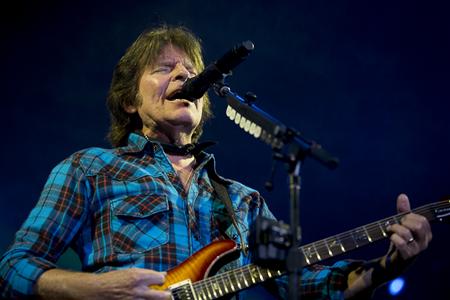
Of course, there are the obvious places to start – Cold Chisel on the opening night who showed no signs of age as they ripped through a two hour set of a mixture of classics, obscurities and new songs from latest record, No Plans.  John Fogerty who laid down Cosmo’s Factory on the Saturday night, then Green River (both in their entirety) on the Monday night, along with a string of Creedence hits, wowing crowds with his energy and passion.  Or John Butler who played a set-by-numbers, but whose energy made up for that and then some.

Then again, you could start in the less obvious places.  Eilen Jewell and her black-clad band, mixing scintillating surf guitar sounds perfectly with western swing, her sultry vocal melting hearts and minds, a true delight to see. Jewell celebrated her 33rd birthday on the day of the band’s second set, but it was her giving the gifts, a truly fantastic spectacle.

Eilen Jewell
And then there’s Justin Townes Earle, who at six foot five, skinny as a rake, perpetually wreathed in cigarette smoke, had the crowds spellbound as he told tales tall and true, this time around with an acoustic guitarist and upright bassist as his foils.  His guitar work has people straining to see a loop pedal, but there is none.  His lyrics have wannabe songwriters turning themselves inside out trying to replicate, but they can’t.  This man is the real deal, his sets highlights, his talent vividly apparent.

His father, Steve Earle, is obviously the well from where this talent flows, the elder Earle drawing you in with tales of his own, the man is a born storyteller.  Whilst his second set was drowned out somewhat by G3 on the Mojo Stage, there’s no escaping his innate ability to so simply convey a story through song.

Justin Townes Earle
For the more raucously inclined, there were the likes of Dallas Frasca, whose sets get bigger, heavier and rawer every time I see them, matched by Marshall O’Kell, who blew the roof off the Cavanbah Stage on the Saturday afternoon to a crowd more suited to somewhere like Wacken, as opposed to Bluesfest.  These two are on their own trajectories, and it was excellent to see they’re evolving so solidly from lacklustre records released a year or so ago.

The aforementioned G3, whilst epic as far as guitar pyrotechnics go, bordered on both the insane and the mundane – you’ve really got to be into what they’re selling to sit there for two and a half hours; there’s such a thing as too much guitar.  Still, to wander past every half an hour or so and bathe in the insanity was a fine thing to be sure – everything is good in moderation.

It has become apparent that Lachlan Bryan, frontman for Melbourne alt.country band The Wildes, is equally as mesmerising on his own.  With just him, his guitar and a percussionist using a snare and brushes, Bryan spun many a tale – he’s certainly into his murder ballads – with a voice like molasses and guitar skill to match.  Think Jordie Lane, but more of a country bent, and you’ve got Lachy Bryan, who is destined for bigger things.

Lachlan Bryan
It didn’t rain this year, for the first time in the festival’s existence apparently, and temperatures reached those of mid-summer, an odd prospect for this part of the world at Easter time, and so there was a carefree vibe floating over the festival this year.  Numbers were down slightly (as you’d expect, given the almost unbelievable strength of last year’s lineup) and so there was room to move, a true Byron Bay experience indeed.

Canadian Harry Manx once again brought his east-meets-west ethos, and with local boy Lachlan Doley on keys, added some extra depth to his Indian raga-influenced blues sounds.  Hat Fitz and Cara Robinson expertly melded blues with Celtic influence with finger-snapping results; Joanne Shaw Taylor melted faces with some expert electric blues guitar wrangling; and Maceo Parker brought the funk, New Orleans style, his show late on the Monday night the cure for what ailed everyone, which at that point was exhaustion and perhaps, for some, overindulgence in beer, wine, what have you.

David Crosby had recovered from his vocal problems of the previous week, and with Steve Stills proving he’s one of the best guitarists out there, CSN laid down a heavy, dark set which had old hands ecstatic, and new comers converted – age has not wearied.

Sublime and Slightly Stoopid were also on the bill this year, but aside from that do not deserve a mention.

Where to from here?  Seasick Steve with John Paul Jones on bass and mandolin – exceptional.  My Morning Jacket – confusing and exciting, all at once.  Brian Setzer – is it about the hair or the guitars?  A three-way double bass-off though, that’s something you don’t see every day.  Angelique Kidjo – how did she fit that many crowd members on stage?  There must have been 100 up there.  Zappa Plays Zappa and Yes – what, exactly, is happening there?  Good, though.

Fogerty
And so it came to an end, things melding into others, sounds ringing in your ears, dust in your nose, unused drink tickets in your pocket (possibly).  A festival that, big name-wise, wasn’t as huge as 2011, but that musically ticked all the boxes and created some new ones.  It just shows that even if the headliners don’t overly excite you, there is always something lurking just beneath the surface, waiting to grab you just right.  That was certainly the case this year, and no doubt will be for years to come.  A fine festival all ‘round.

Samuel J. Fell

Tuesday, 10 April 2012

Live Interviews - Bluesfest '12 - Rhythms Q&A Sessions

My interviews with various artists on the Cavanbah Stage for the Rhythms Q&A Sessions at Bluesfest, 2012.

Mason Rack


Podcast Powered By Podbean

SJF interviewing a very relaxed Claude Hay
Claude Hay


Podcast Powered By Podbean